


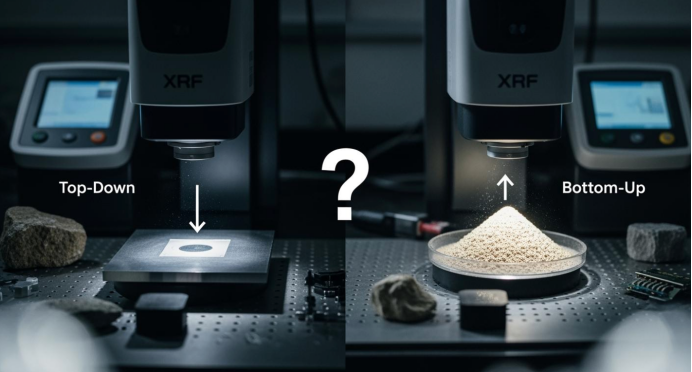
When choosing an X-ray fluorescence (XRF) spectrometer for minerals, metals, refractories, or powder analysis, one critical decision often confuses buyers:Should you choose top-down or bottom-up illumination?
This post explains the real differences, application scenarios, and cost implications in clear, professional terms — no jargon, no sales pitch.
What Are Top-down & Bottom-up XRF?
Top-down (Upper Illumination)X-ray tube and detector are located above the sample chamber. The sample faces upward during testing.
Bottom-up (Lower Illumination)X-ray tube and detector are located below the sample chamber. The sample faces downward during testing.
The structure directly determines performance, safety, maintenance, and applicable industries.
Key Comparison: Top-down vs Bottom-up XRF
1. Sample Compatibility
Top-down: Ideal for irregular samples, large rocks, ore blocks, castings, core samples, and loose powders.No cutting or grinding required — supports non-destructive testing.
Bottom-up: Only suitable for standard pressed pellets, fused beads, liquids, and small, flat samples.
2. Safety & Maintenance
Top-down: Extremely safe. Powder spills or liquid leakage will not damage the X-ray tube or window.Longer instrument life and lower maintenance cost.
Bottom-up: Risk of contamination. Broken pellets or leaked samples can directly damage the tube — expensive to repair.
3. Stability & Precision
Top-down: Flexible positioning, excellent for on-site and rapid screening.
Bottom-up: Fixed optical path, high repeatability, stable for lab-based standardized testing.
4. Cost
Top-down: Higher initial investment, but better durability and wider usability.
Bottom-down: More affordable, compact, and cost-effective for standardized labs.
Which One Should You Choose?
Choose TOP-DOWN if you work in:
Mining & mineral processing (olivine, ores, raw minerals)
Refractory materials
Metal scrap & casting
Large or irregular sample testing
On-site / non-destructive analysis
Link:https://en.sddygd.com/xyggpy/84.html (DF1000E)
Choose BOTTOM-UP if you work in:
Standard laboratory testing
Pressed pellet / fused bead analysis
Liquid sample testing
Budget-sensitive fixed lab applications
Final Takeaway
Top-down = Versatile, Safe, DurableBottom-up = Affordable, Stable, Standardized
There is no “universally better” — only the one that fits your sample, industry, and long-term cost structure.
For mineral, refractory, and ore industries, top-down illumination is widely recognized as the more practical and reliable choice.
Link:https://en.sddygd.com/xyggpy/81.html(DF1500)
Link:https://en.sddygd.com/xyggpy/85.html(DF1000)
Link:https://en.sddygd.com/xyggpy/86.html(DF1600)
Link:https://en.sddygd.com/xyggpy/80.html(DF1800)



 Sales Line: +86 18660008769
 Email: dongfang@dfaic.com
 Add:No.28 Chuangxin Road, High-tech Zone, Yantai, Shandong


