


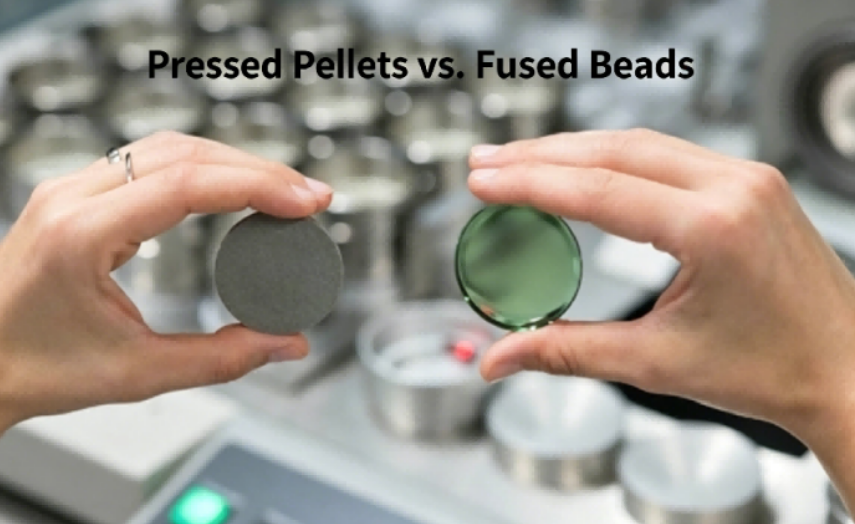
In EDXRF (Energy Dispersive X-ray Fluorescence) analysis, sample preparation is critical for accurate results. The two most common methods—pressed pellet and fused bead—each shine in different scenarios. Choosing the wrong one can lead to misleading data.
When to Use Pressed Pellets?
Pressed pellets are made by mixing powdered samples with a binder and compressing them into flat disks under high pressure. They’re fast, cost-effective, and non-destructive, ideal for:
Ores & geological samples: Soils, sediments, and rock powders for rapid screening of major and trace elements.
Cement & construction materials: Raw meal, clinker, and fly ash for quality control and composition analysis.
Metal powders & alloys: Iron, aluminum, and welding powders with relatively uniform composition.
Environmental samples: Fly ash and sludge for quick heavy metal detection.
Pros: Simple operation, low cost, and high throughput for large sample batches.Cons: Susceptible to particle size, mineralogical, and matrix effects; limited accuracy for light elements (e.g., Na, Mg).
When to Use Fused Beads?
Fused beads are created by mixing samples with a flux (e.g., lithium tetraborate), melting at high temperatures, and cooling into homogeneous, amorphous glass disks. They eliminate mineralogical and particle size effects, making them the gold standard for high-precision analysis:
Complex geological samples: Ores and concentrates requiring precise major element (e.g., Fe₂O₃, SiO₂) and trace element analysis.
Refractory materials & ceramics: Alumina, zirconia, and other complex materials with strict accuracy demands.
Environmental & industrial samples: Low-level element detection or samples with volatile components (e.g., sulfur, chlorine).
Certified reference material preparation: Ensuring traceable, reliable calibration standards.
Pros: Eliminates mineralogical and particle size bias, delivering exceptional accuracy—especially for light and trace elements.Cons: Complex, time-consuming, and costly; requires skilled operators and fully consumes the sample.
�� One-Sentence Decision Guide
Prioritize speed and cost with relatively uniform samples and moderate accuracy needs → Choose pressed pellets.
Demand maximum precision for complex samples, light elements, or trace analysis → Choose fused beads.
At events like PDAC, we often discuss this workflow with geologists: handheld XRF for on-site screening (similar to pressed pellet logic) and fused beads for lab-grade accuracy. Together, they form a complete elemental analysis ecosystem.



 Sales Line: +86 18660008769
 Email: dongfang@dfaic.com
 Add:No.28 Chuangxin Road, High-tech Zone, Yantai, Shandong


