


The Core Technical Difference: How Each Technology Separates X-Ray Photons
Energy Dispersive XRF (EDXRF): Speed Through Simultaneity
EDXRF instruments use a semiconductor detector — either a silicon PIN diode or, in higher-end systems, a Silicon Drift Detector (SDD) — to measure the energy of each incoming fluorescent X-ray photon directly. Because the detector captures all energies simultaneously, a complete multi-element spectrum is acquired in seconds. The SDD variant achieves energy resolutions approaching 125–130 eV at the Mn Kα line — close to the theoretical Fano limit for silicon detectors. This simultaneous detection is what makes EDXRF so fast: an XRF gold analysis on a VRAY VR-S6 takes approximately 3 seconds.
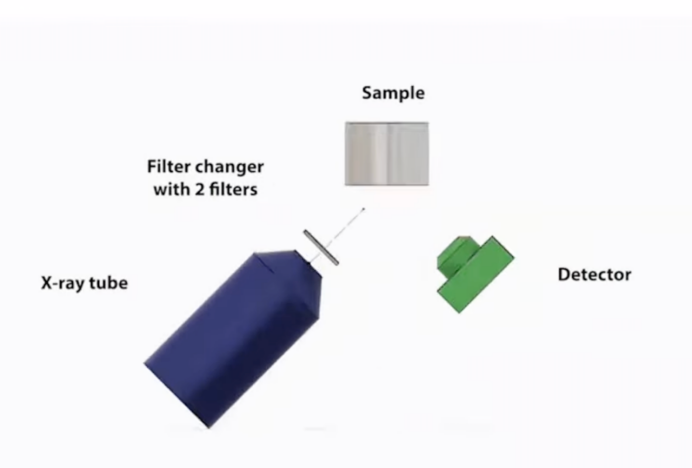
The limitation is spectral overlap. When two elements produce fluorescence lines at very similar energies — for example, arsenic Kα (10.54 keV) and lead Lα (10.55 keV) — an EDXRF detector with 150–300 eV resolution cannot fully separate them without software deconvolution. At 125–130 eV (SDD), overlap is manageable for most metallurgical matrices, but remains a real consideration for complex low-Z samples.
Wavelength Dispersive XRF (WDXRF): Precision Through Crystal Diffraction
WDXRF instruments diffract outgoing fluorescent X-rays through analyzing crystals, each optimized for a specific wavelength range, then count them with a proportional or scintillation detector. Because photons are separated by Bragg diffraction rather than semiconductor energy resolution, spectral resolution reaches 5–20 eV — ten to fifty times sharper than EDXRF. This resolving power is essential for overlapping lines in complex matrices and for detecting ultra-trace concentrations of light elements.
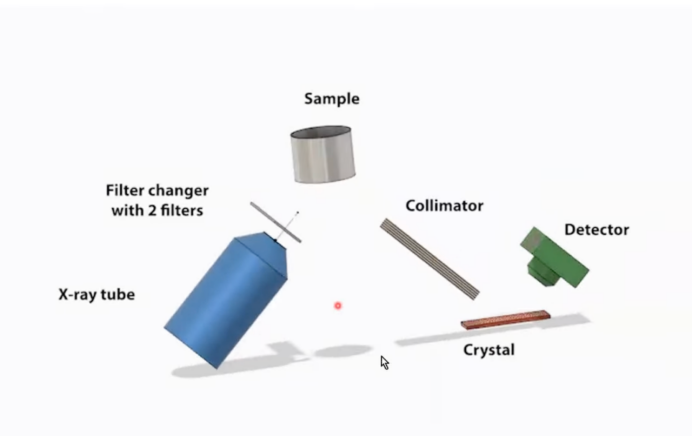
The cost of this precision is sequential detection: a WDXRF spectrometer must rotate through each analytical channel individually. A complete multi-element analysis takes 3–15 minutes, compared to seconds for EDXRF. Tube power requirements are also dramatically higher: WDXRF typically requires 1,000–4,000 W X-ray tubes versus 1–100 W for EDXRF, increasing infrastructure costs, cooling requirements, and electricity consumption.
Comparison
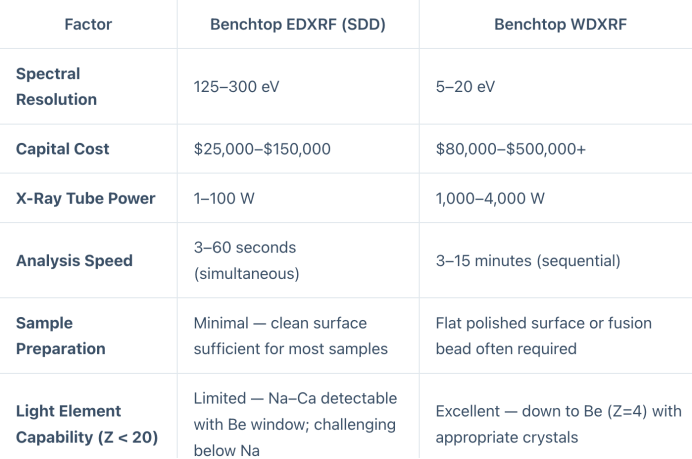
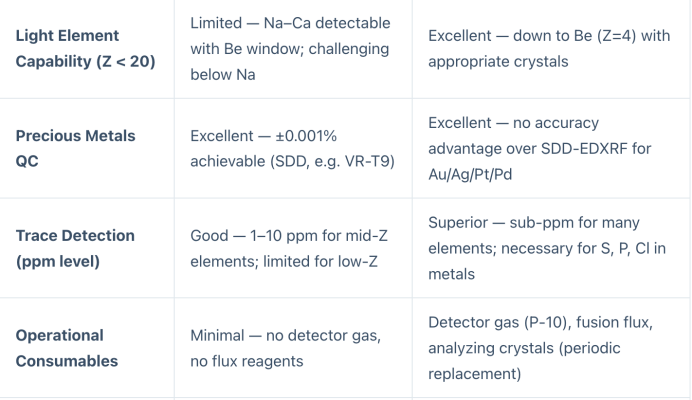
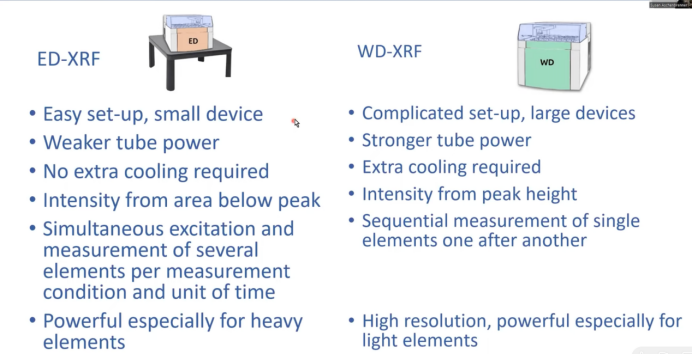
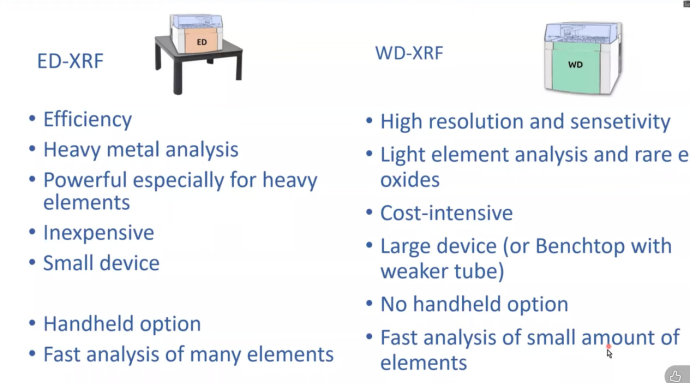
Before purchasing the equipment, please ask yourself these questions and follow the recommendations:
Recommendation: Choose EDXRF for a wide element range (Mg to U) without ultra-trace light elements. Choose WDXRF for ultra-trace light elements or overlapping spectral lines in complex matrices (5-20 eV high resolution for accurate identification).
Recommendation: EDXRF is suitable for 10-100ppm tolerance; WDXRF is for several ppm tolerance.
Recommendation: Choose EDXRF for simple sample preparation (no grinding, solidification or special carriers). Choose WDXRF for strict sample preparation and higher accuracy.
Recommendation: Choose EDXRF for limited budget (lower cost, 1-100W X-ray tube, low maintenance). Choose WDXRF for sufficient budget and high-precision/ultra-trace detection (1000-4000W X-ray tube).
Link: https://en.sddygd.com/xyggpy/81.html(DF1500)



 Sales Line: +86 18660008769
 Email: dongfang@dfaic.com
 Add:No.28 Chuangxin Road, High-tech Zone, Yantai, Shandong


